Model-agnostic
Anthropic, OpenAI, Google, or local. Choose the best model per workflow; rewrite nothing when the model changes.
Anthropic, OpenAI, Google, or local. Choose the best model per workflow; rewrite nothing when the model changes.
MCP, REST API, databases, SAP, Jira. Integrates with every system you use — you can even add your own tool.
Design agents and approval steps without being a developer. Business unit leaders set up the process themselves.
Human approval, audit, RBAC, cost limits. On-prem or cloud. Compliance from day one.
Each business unit is tied to a different vendor and a single model that will become obsolete after six months. Tools don’t talk to each other; people still fill the gap between them manually.
Cortex spans the entire platform — end-to-end agentic workflows from trigger to integration
A user or administrator starts the workflow.
Webhook, queue, or event-driven trigger.
Cron or periodic task trigger.
Agent runtime environment — task context, file access, and workspace management.
Multi-step flows and approval steps via drag-and-drop designer.
Enterprise context layer — code, Jira, and Confluence indexing, semantic search.
Task-specific AI agent reasoning via ReAct loop.
Multi-model routing by task; cost-performance balance.
Human approval at critical steps — the flow never proceeds unapproved.
RBAC, cost limits, and full audit trail — every action passes the policy filter.
Enterprise ERP integration.
Identity and directory service integration.
External services and microservice connections.
Relational and NoSQL data sources.
Everything is monitored from a single panel. See what’s happening in a workflow within seconds.
15 active agents across SDLC, DevOps, infrastructure, and documentation. Customer-specific agents can be added to the same library.
Ideation and brainstorming for creative problem solving.
Indexes the code repository into a vector database.
Complex reasoning and deep analysis.
Comprehensive code review and security analysis.
DevOps and release operations.
API and code documentation generation.
Analyzes documentation gaps.
Excel ticket parsing and scoring.
Analyzes specification documents.
Kubernetes operations and SRE assistant.
Automated test scenario generation.
Unit test generation.
Veeam Backup & Replication operations.
Veeam infrastructure indexing.
VMware vSphere infrastructure management.
Software Development Life Cycle
Software team focusing on high-value-added work
DevOps & Operation Monitoring
Not raw logs, but a management summary ready for the morning meeting.
Automated Interview Candidate Screening
From hundreds of CVs, the top 10 candidates in minutes.
Knowledge & Document Automation
Automatic gap detection, content generation, and approval for documentation.
Veeam · VMware · SRE
Infrastructure operations automation with human oversight.
Comparing senior developer effort vs. Coder Agent results on a 19-module HCM platform — 8–10 business days vs. 11 h 41 min
Corporate HCM platform for a leading e-commerce group in Turkey: 19-module monorepo on .NET Core 3.1 with multi-host and microservice architecture.
The platform needed upgrading to .NET 10, resolving enterprise-scale risks including package incompatibilities, Autofac DI patterns, EF Core model drift, and security vulnerabilities.
An experienced developer carried out the .NET upgrade on the same codebase using traditional methods. Estimated time and cost were calculated against corporate team planning.
The same upgrade was automated end-to-end with Cortex Coder Agent: 12 tasks, 14 commits, each task completed with its own verification step.
System built successfully and is currently under QA validation. Pre-production steps such as HTTP smoke tests, DBA SQL dry-run, and secret rotation remain open.
Putting agentic systems into production is not as easy as a demo; it lies in security and control mechanisms. Cortex solves them all from day one.
Retrospective traceability in decisions, data reading, and tool calls.
Budget limits per user and workflow, automatic overage stop.
Agent suggests in critical decisions, human approves — human-in-the-loop.
Who can access which agent and tool is managed from a single center.
Change the model with one click at midnight in case of provider violation.
Your data stays in your infrastructure. On-prem deployment, EU and TR data localization compliance — ready for regulation.
| Classic RPA | Single-vendor AI (MS/Google) | Custom Build | Cortex | |
|---|---|---|---|---|
| Capacity | Fragile rules | Understands context | Understands context | Reasoning and context understanding |
| Independence | Limited | Vendor lock-in (locked) | Free | Completely independent of model and tool |
| Speed / Time-to-Market | Slow | Fast | Takes 6+ months | Day one (ready enterprise framework) |
| Governance | Weak | Dependent on ecosystem | Must be written from scratch | Built-in (audit, approval, RBAC) |
Cortex by BGTS
In a 30-minute demo, let’s automate one of your currently fragmented processes — SDLC, IT operations, HR, or finance — by running it live in Cortex.
Schedule a demoAn intelligent platform that automatically joins your enterprise team meetings, records audio, generates transcripts, and maximizes their value with AI-powered analysis. Available as cloud and on-premise deployments.
Bring clarity to conversations — turn words into work.
Reads your calendar and automatically joins scheduled meetings.
Safely backs up everything spoken with high-quality audio recording.
Turns speech into text with speaker diarization — who said what.
Detects decisions and action items with AI-powered analysis.
Every step is managed automatically, from kickoff to completion — an end-to-end pipeline from calendar to work-tracking tools.
Meetings are detected automatically via calendar integration.
One-click bot control — add the bot before or during a meeting.
The virtual assistant joins the call via rule-based or manual triggers.
High-quality audio and data capture becomes active.
Audio is turned into text with an accuracy score and a full audit trail.
Decisions, action items, owners, and risks are extracted from the transcript.
Each utterance is clearly attributed to its speaker.
Ask questions in natural language even mid-meeting; searches past data and the live transcript.
Automatic ticket creation and owner assignment.
Card creation and assignment with priority and due date.
Work item creation and automatic action detection.
Reports, weekly summaries, and organizational insights.
Reads your calendar and joins by rule; never miss a meeting.
One-click bot control; the attendance setting lets meetings be captured without you.
Speaker diarization clearly separates who said what.
Click any line of the transcript and instantly hear the matching audio.
Confidence-scored transcripts; who edited what and when — full change history.
Ask questions by voice mid-meeting; past data and the live transcript are searched.
Talk to your data in natural language; query a single meeting or a whole channel.
Ready-made templates per meeting type (e.g. sprint, sales, interview, one-on-one); build your own with custom criteria so analysis outputs follow the same structure in every meeting.
Weekly summaries, trend analysis, and risk detection — see the big picture.
Problem: Decisions made in meetings stay verbal; who does what by when is unclear.
Flow: AI extracts the action, its owner, priority, and due date from the transcript and turns it into a Jira/Trello ticket.
Outcome: Every decision automatically becomes an assigned work item.
Problem: "What did we decide about this last sprint?" slows the meeting down.
Flow: Ask the voice assistant; past data and the live transcript are searched, and the answer can be shared as a document.
Outcome: Instant analysis and historical context at hand, without interrupting the meeting.
Problem: Meeting knowledge is scattered across personal notes; it leaves when people do.
Flow: The chatbot uses every completed meeting's transcript and AI analysis as its source; query by project or team.
Outcome: Meetings become searchable, permanent corporate memory.
Problem: Every meeting is summarized differently; outputs cannot be compared and key topics get missed.
Flow: A template matching the meeting type is selected (sprint, sales, interview, etc.) or a new one is defined with custom criteria; AI produces the analysis with the same heading structure in every meeting.
Outcome: All meeting outputs become standard, comparable, and complete.
Problem: The big picture across many meetings — decisions, delays, trends — is invisible.
Flow: The dashboard shows meeting, decision, and action counts at a glance; risk analysis surfaces overdue actions and trend analysis surfaces hot topics.
Outcome: Team productivity is monitored from above; risks are caught early.
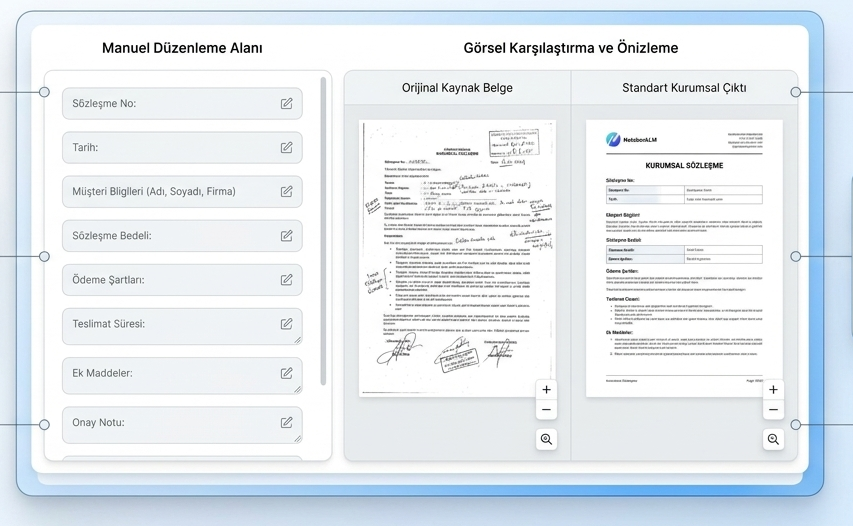
DOC-CONVERTER analyzes all scattered files uploaded to the system (PDF, DOCX, PPTX, etc.) with AI support and integrates them into your corporate template within seconds.
With DOC-CONVERTER, convert all your corporate documents — contracts, reports, and technical specifications — into a single, standard format aligned with your corporate identity.
A comparable, legally compliant, and organized corporate data archive across the entire company.
Redirect thousands of hours spent on manual document editing to strategic operations and growth.
A smooth, accelerated, and trackable workflow for managers and operations teams.
Word files, complex PDFs, non-standard technical reports... Manually editing disorganized corporate data to read it and make it compatible with company systems is the biggest time waste across all departments.

DOC-CONVERTER analyzes all scattered files uploaded to the system (PDF, DOCX, PPTX, etc.) with AI support and integrates them into your corporate template within seconds.
PDF, DOC, DOCX, and PPTX — corporate documents such as contracts, reports, and technical specifications.
Process dozens of documents at once for department-scale speed.
AI-powered analysis and integration into your corporate template.
Scattered files converted into a standard corporate format within seconds.
Review critical fields; compare the original source document with the output side by side.
Instantly download the flawless, up-to-date corporate document as an approved PDF.
AI-powered conversion, bulk upload, job queue, and manual editing — on one platform, for every department.
Scattered files uploaded to the system are analyzed with AI and integrated into your corporate template within seconds.
Process dozens of documents at once for department-scale speed.
Works system-independently; supports PDF, DOC, DOCX, and PPTX formats.
Manage pending document flows from all departments on one central screen.
Review and edit critical fields as needed (e.g. add a missing clause or approval note to a contract).
Compare the original source document with the standard output side by side for zero-error assurance.
DOC-CONVERTER analyzes all scattered files uploaded to the system (PDF, DOCX, PPTX, etc.) with AI support and integrates them into your corporate template within seconds.
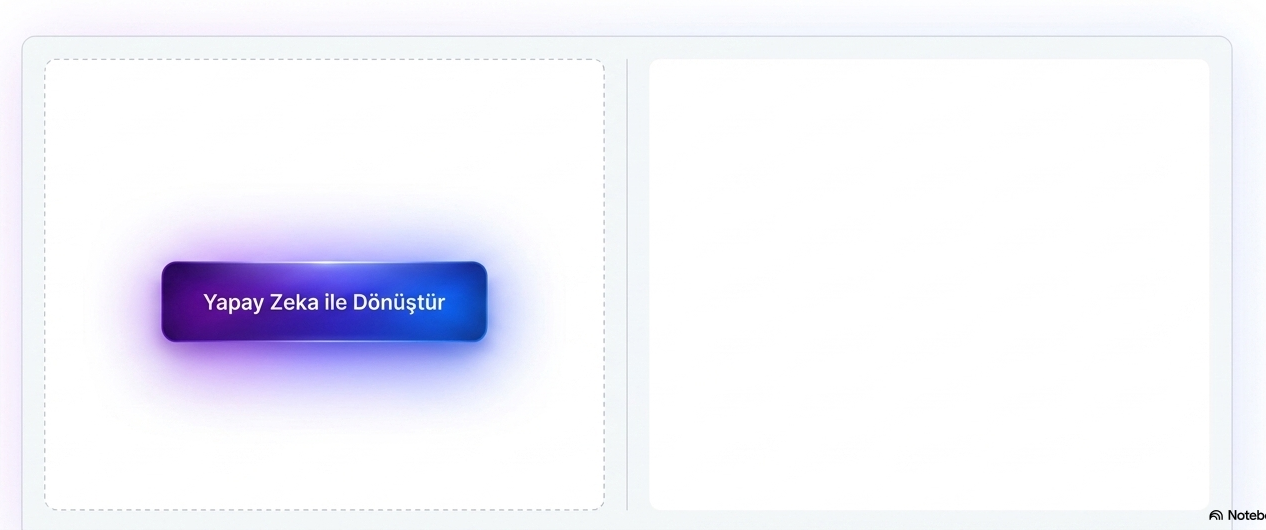
Bulk upload of contracts and reports for all departments completely eliminates the manual data entry bottleneck.
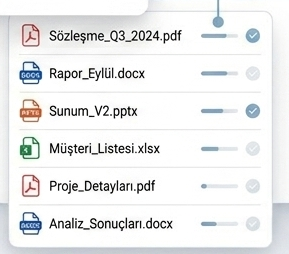
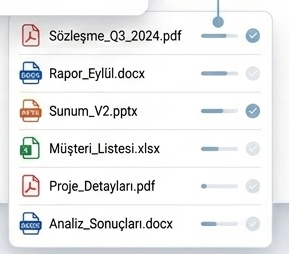
Keep operational processes transparent; let no critical contract or report be overlooked.
Edit critical fields; compare the original source document with the generated standard corporate output side by side.
After making edits, instantly download the flawless and up-to-date corporate document as an approved PDF.
VideoBot is a next-generation platform that fully digitalizes HR interview processes, lets candidates be assessed on video in their own time, and enables objective decisions through an AI-powered analysis engine. It eliminates the hidden costs of traditional interviews — time loss, bias, and scaling problems — with a smart workflow managed from a single screen.
Digitalize your interview processes and evaluate candidates with artificial intelligence.
Calendar coordination ends. Candidates join on their own schedule; the process runs asynchronously.
Every candidate is evaluated to the same standard. Human bias is removed from the process.
Same operational ease with 10 candidates or 1,000. The system grows with you.
Routine operations are automated; HR teams focus on strategy, not operations.
Planning work that takes days turns into a digital action that takes minutes — every step from candidate upload, interview design, and criteria definition to invitations, recording, AI analysis, and decision reporting on one platform.
Bulk upload via Excel or CSV; names, emails, and contact details in a central database.
Interview design with questions, avatar videos, silence and maximum duration settings.
One-click invitation email with template selection, duration (days), and candidate list; automatic reminders and status tracking as deadlines approach.
Candidates record in their own time; all answers stored in the cloud, watchable on demand.
Score out of 100, recommendation (Positive/Negative/Uncertain), and executive summary per defined criteria.
Position-specific criteria (e.g. communication skills, technical competence, problem solving) and their weights are defined; the AI analysis engine evaluates against this guide.
Latest evaluations, performance metrics, comparative candidate reports, and bird's-eye process tracking on one screen.
Save time by managing resource management steps and resource transfers through this screen.
Make fast and informed decisions by following all process details with a bird's-eye view.
Optimize recruitment processes by reviewing performance metrics and related comments through this panel.
Bulk candidate upload or single addition in seconds with Excel or CSV.
Instant search by name and email.
Automatic tracking of name, contact information, and dates added to the system.
Opportunity to assign an avatar video reflecting company culture for each question.
Flexible and customizable interview templates.
Silence duration for the candidate to think and maximum duration limits for answers. Automatic transition to the next question.
Easily add, edit, and sort questions.
Monitor real-time status of all sent interviews (Waiting, In Progress, Completed) from a single screen.
Automatic listing of interview link expiration dates.
Authority to view details, resend the interview with one click, or cancel.
The AI engine automatically analyzes each candidate according to defined criteria and scores them out of 100.
Instant guidance in the form of Positive / Negative / Uncertain.
A detailed, automatically generated executive summary explaining each candidate's strengths and weaknesses.
Transfer all data to internal systems within seconds via Excel export.
Problem: Hours of email traffic; calendar coordination is the biggest time drain for HR teams.
Flow: Automatic invitation email with one click via template selection, duration setting, and candidate list; the candidate records in their own time.
Outcome: Async video interviews eliminate calendar coordination; the process starts in minutes instead of days.
Problem: Traditional interviews are subjective and inconsistent; each candidate is evaluated to different standards.
Flow: AI-supported, 100% objective scoring with position-specific weighted criteria and LLM scoring guides.
Outcome: All candidates pass through the same filter; clear guidance with Positive / Negative / Uncertain recommendations.
Problem: Scaling is limited due to manual effort; 10 candidates and 1,000 candidates cannot be managed with the same operational ease.
Flow: Scale your operation with one click: multi-candidate selection, bulk invitations, and real-time process monitoring for unlimited candidate management.
Outcome: Same operational ease with 10 or 1,000 candidates on a single platform; the system grows with you.
Problem: Traditional interview answers are volatile, instantaneous, and irreversible; recording and archiving are problematic.
Flow: All video answers are recorded in the cloud; interview statuses (KVKK Approved, In Progress, Evaluated) are monitored from one screen.
Outcome: Answers can be watched on demand; transferred to internal systems within seconds via Excel export.
A comprehensive HR platform that analyzes candidate CVs, job postings, and interviews with AI — letting you manage the entire hiring process from one screen. It removes manual pre-screening burden and presents candidate–job fit as measurable scores.
A fast, objective, and data-driven next-generation recruitment experience.
Job posting and candidate evaluation complete in seconds.
Consistent, transparent scoring free from personal bias.
Language, technical competence, and experience fit delivered as measurable metrics.
Candidate pool, postings, interviews, and smart assistant on one platform.
Manual processes waste time and budget while candidate–job fit stays unmeasurable. AI Hiring Assistant targets each of these deadlocks.
Manual screening of hundreds of CVs.
Inability to measure candidate–job match.
Failure to accurately assess technical, language, and experience levels.
Inability to effectively evaluate video recordings.
Delayed processes negatively impacting hiring.
Waste of time and budget from prolonged cycles.
From job posting and candidate pool intake to the AI that manages the entire process; from there to scoring, interview support, and smart chat — the full chain managed on one platform.
Created manually or with AI; title, description, and requirements ready in seconds from a URL or file.
Resumes are uploaded to the system; skills, experience, and education fields parsed automatically.
The AI that manages the entire process — orchestrating scoring, interview support, and smart chat.
CV–job matching: two-way, measurable, and transparent percentage fit scores.
Question and video analysis: dynamic question generation aligned with job and candidate, transcripts, and evaluation.
Natural language search: explore the candidate pool with questions and get in-depth analysis via chatbot.
Analyze candidate CVs, job postings, and interviews with artificial intelligence.
Real-time status tracking with metrics; candidate pool, interviews, and postings in one hub.
Upload a URL or file; title, description, and requirements filled in seconds.
Language, technical competence, and experience fit shown as measurable percentages.
Best jobs for a candidate profile; best candidates ranked by score in job detail.
Ask AI for candidate summary, strengths, and weaknesses; speed up decision-making.
Generate questions 100% aligned with the job and candidate, based on defined criteria (e.g. technical competence, experience, foreign language, etc.).
Questions and answers automatically extracted from Teams or other platform video recordings.
Skip complex filter menus — tell the smart assistant: 'List developers who know Java'.
Problem: Hours of manual job writing; inconsistent requirement definitions.
Flow: Upload a URL or file; AI instantly fills title, description, requirements, and skill tags.
Outcome: Before: hours of job writing → After: content ready in 3 seconds.
Problem: Candidate–job fit is unmeasurable; 'why suitable?' goes unanswered.
Flow: % scores across language, technical competence, and experience; mandatory skill matches and gaps tagged.
Outcome: Comparable, transparent scoring for fast pre-screening decisions.
Problem: Burden of reading hundreds of CVs; inability to quickly summarize strengths and weaknesses.
Flow: Open a candidate profile, ask the AI assistant 'Position fit' or 'Which criteria is he weak in?'
Outcome: Candidate summary and strengths list in seconds; faster decision-making.
Problem: Hours of video watching; manual note-taking of questions asked and answers given.
Flow: Upload a video recording; AI auto-detects questions and extracts answers from the transcript.
Outcome: End-to-end video searching ends; evaluation time minimized.
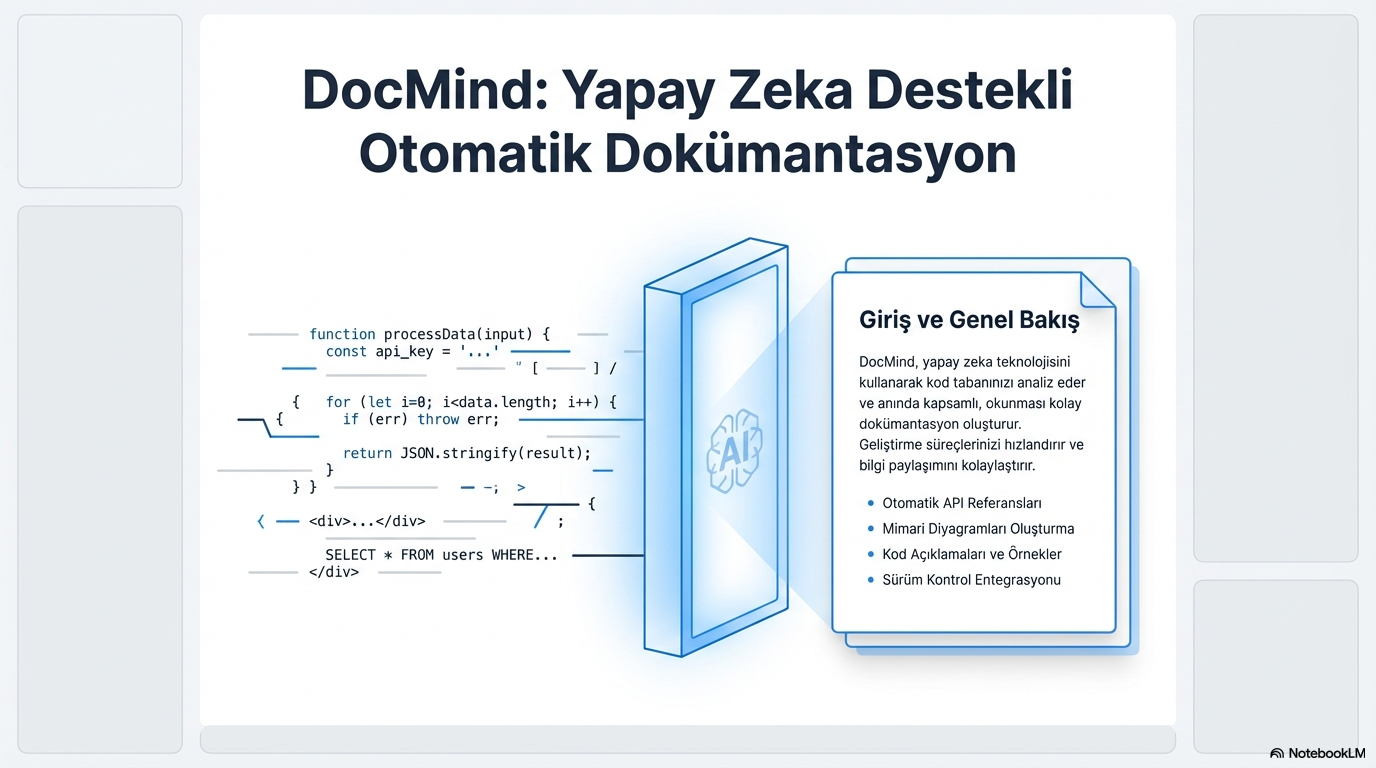
It speeds up your development processes and facilitates knowledge sharing. Your smart tool that generates AI-supported documentation by directly referencing the code repository.
DocMind analyzes your codebase using AI technology and instantly creates comprehensive, easy-to-read documentation.
Extracts endpoints, parameters, and response schemas from the codebase automatically.
Documents system design and technology stack visually.
Explains usage scenarios and code flow with clear examples.
Direct access to code via Bitbucket repo URL and branch information.
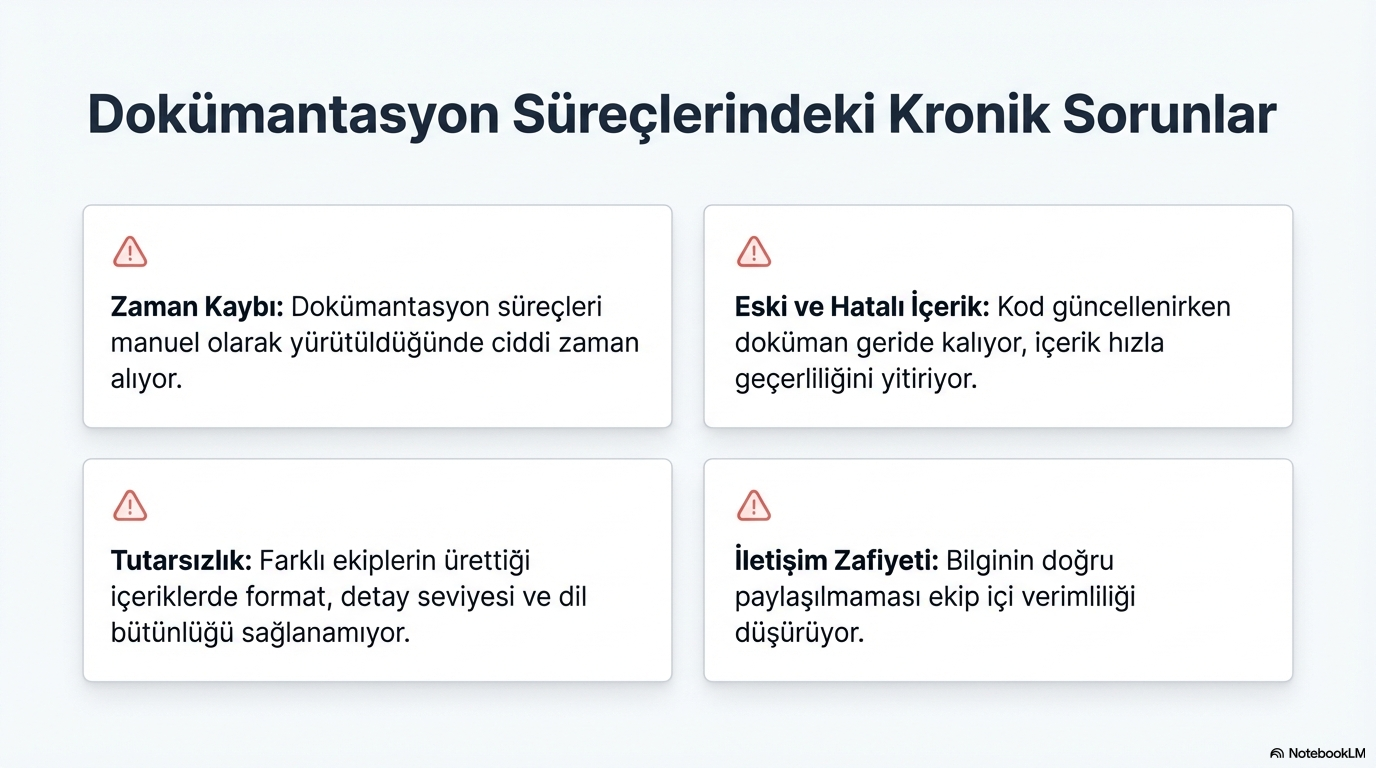
Manual documentation processes are a major productivity drain for teams. Documents lag behind code updates; different teams produce inconsistent content.
Documentation processes take significant time when carried out manually.
While code is being updated, the document lags behind and content quickly loses its validity.
Format, level of detail, and linguistic integrity cannot be ensured in content produced by different teams.
Failure to share information correctly reduces intra-team efficiency.
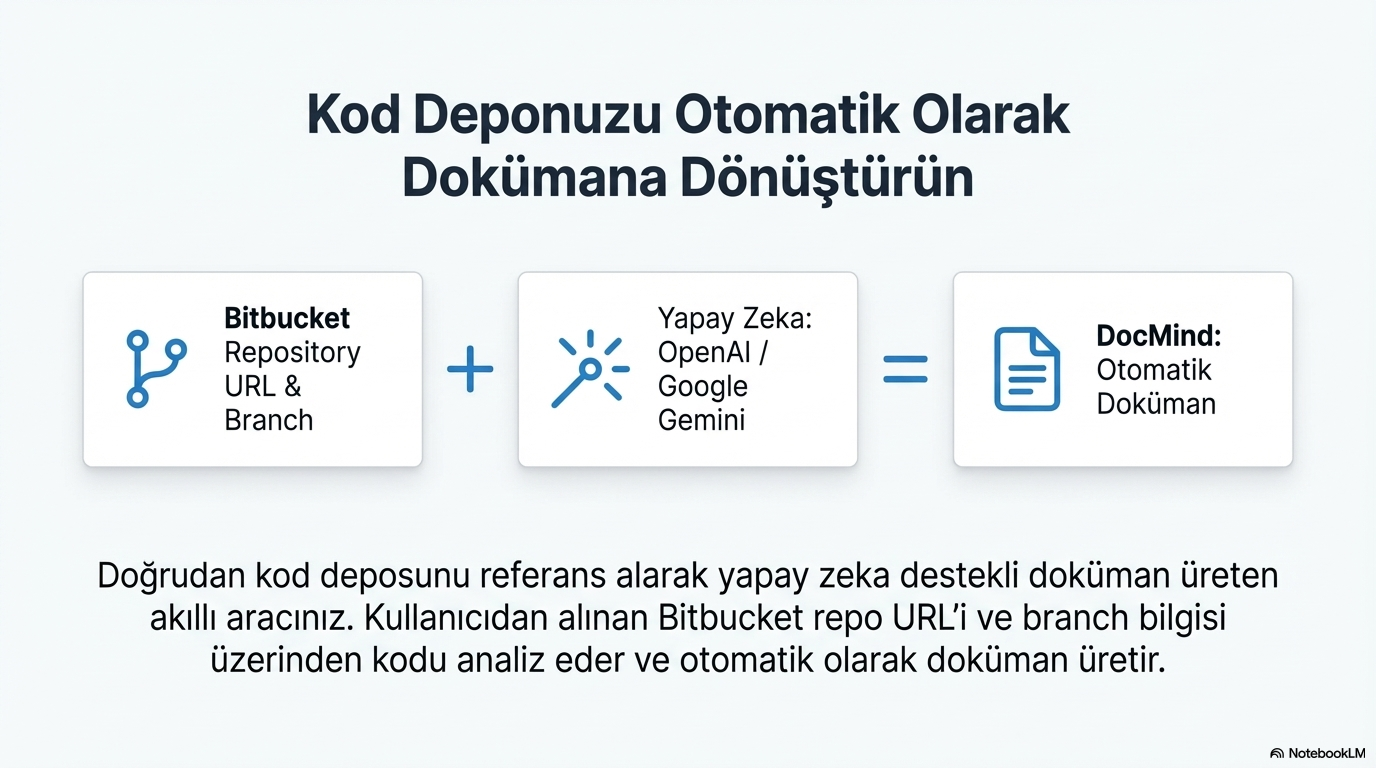
Analyzes code via the Bitbucket repo URL and branch information received from the user; generates documentation with OpenAI or Google Gemini.
Direct access to code via repository URL and branch.
OpenAI / Google Gemini model selection.
Code analysis, section selection, and live preview — central documentation engine.
Real-time Markdown output; table of contents and sections appear instantly.
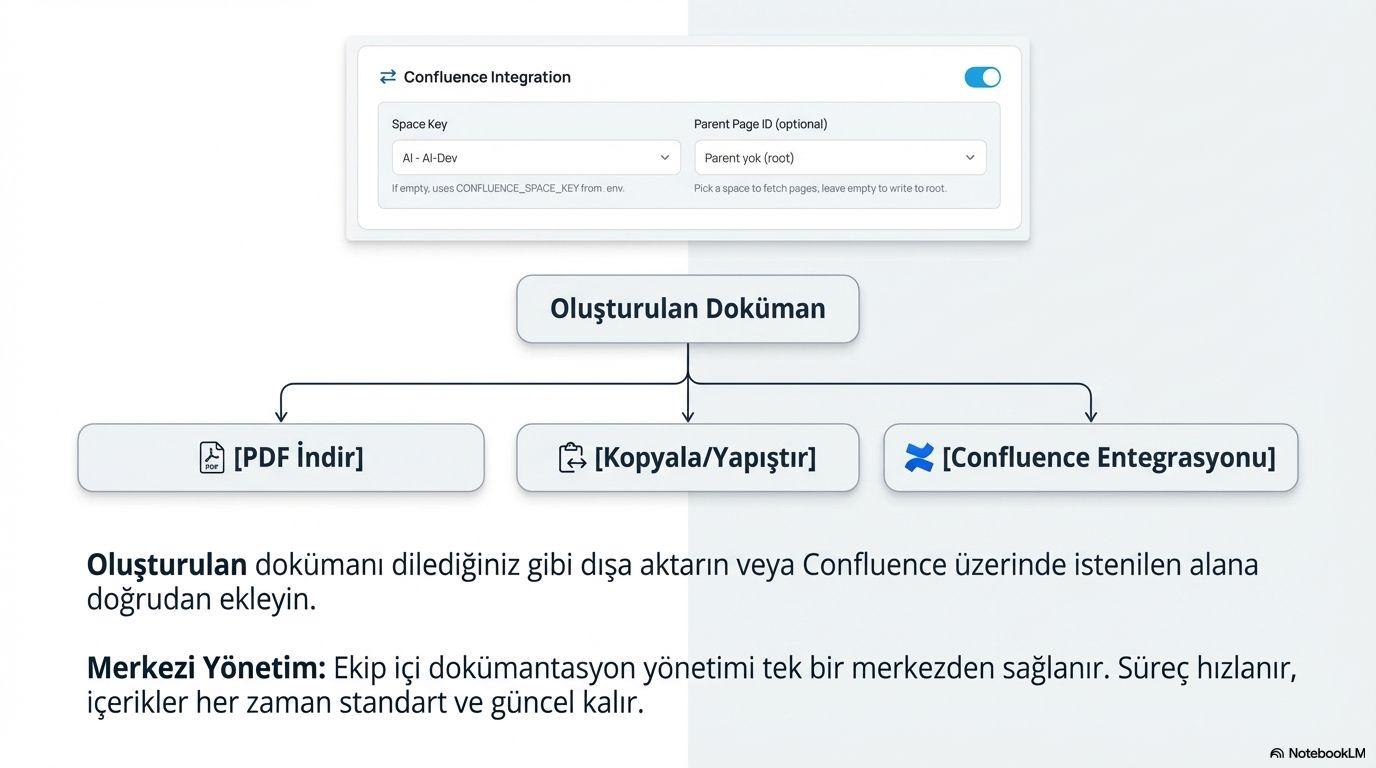
Export the generated document as PDF.
Publish directly to Confluence with space key and parent page.
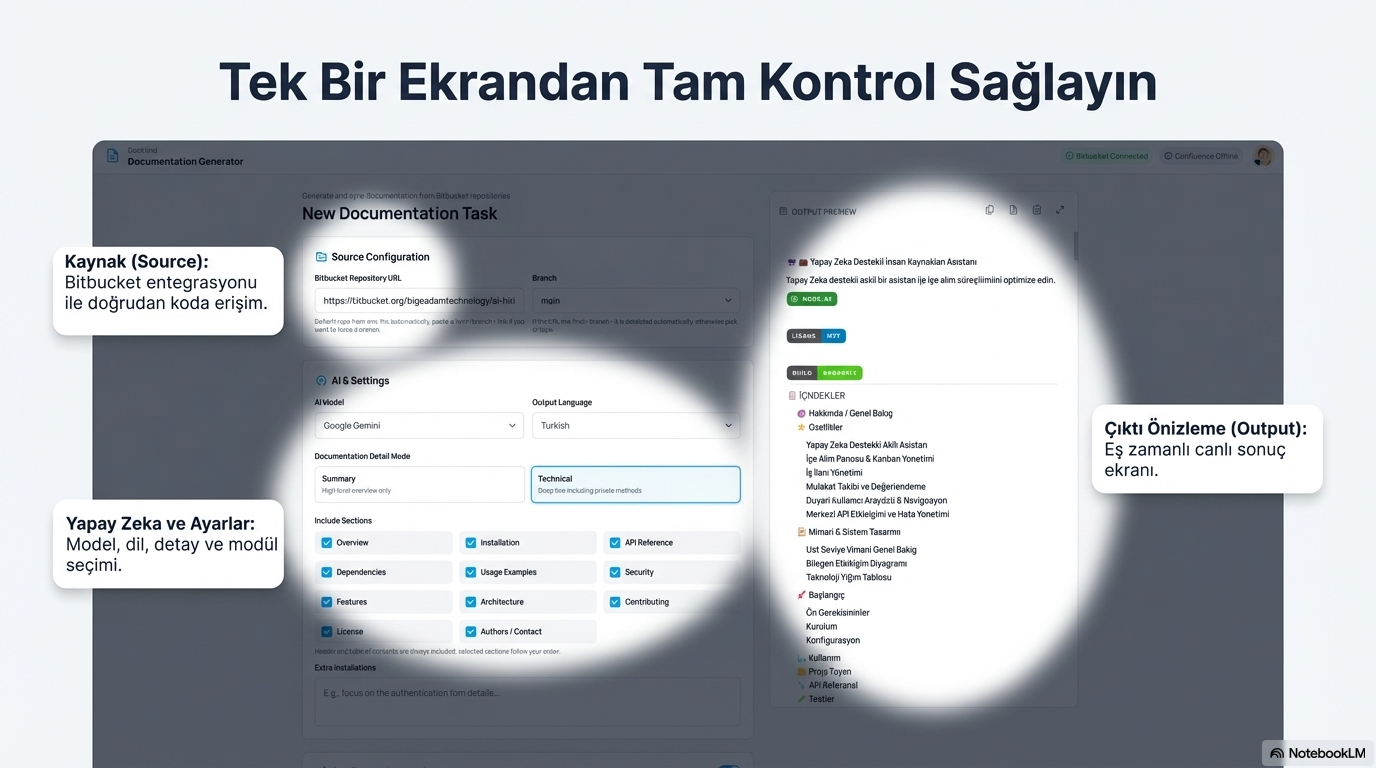
Source configuration, AI settings, and live output preview — all in one interface.
Direct access to code via repository URL and branch selection; connection status visible at a glance.
Choose between OpenAI or Google Gemini; pick the model that fits your project.
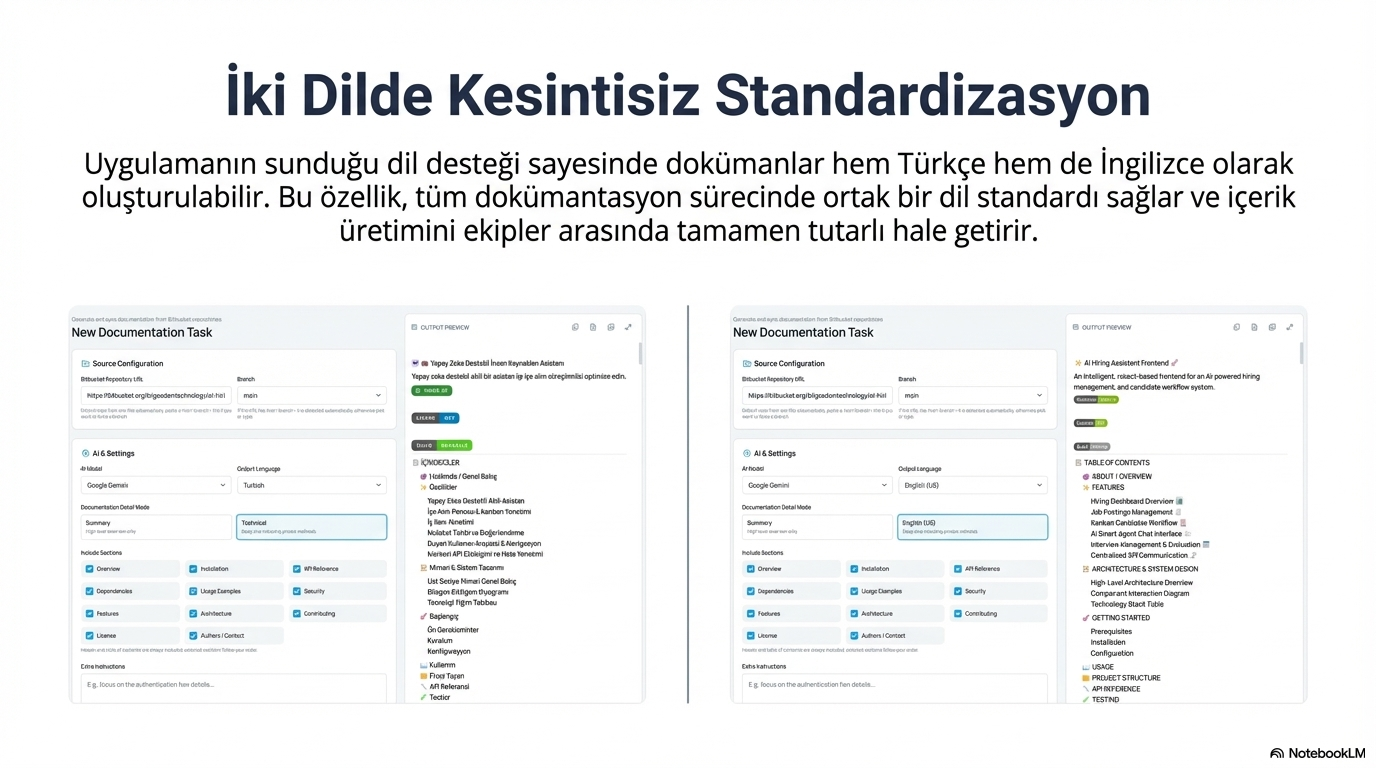
Documents can be created in both Turkish and English; a common language standard across teams.
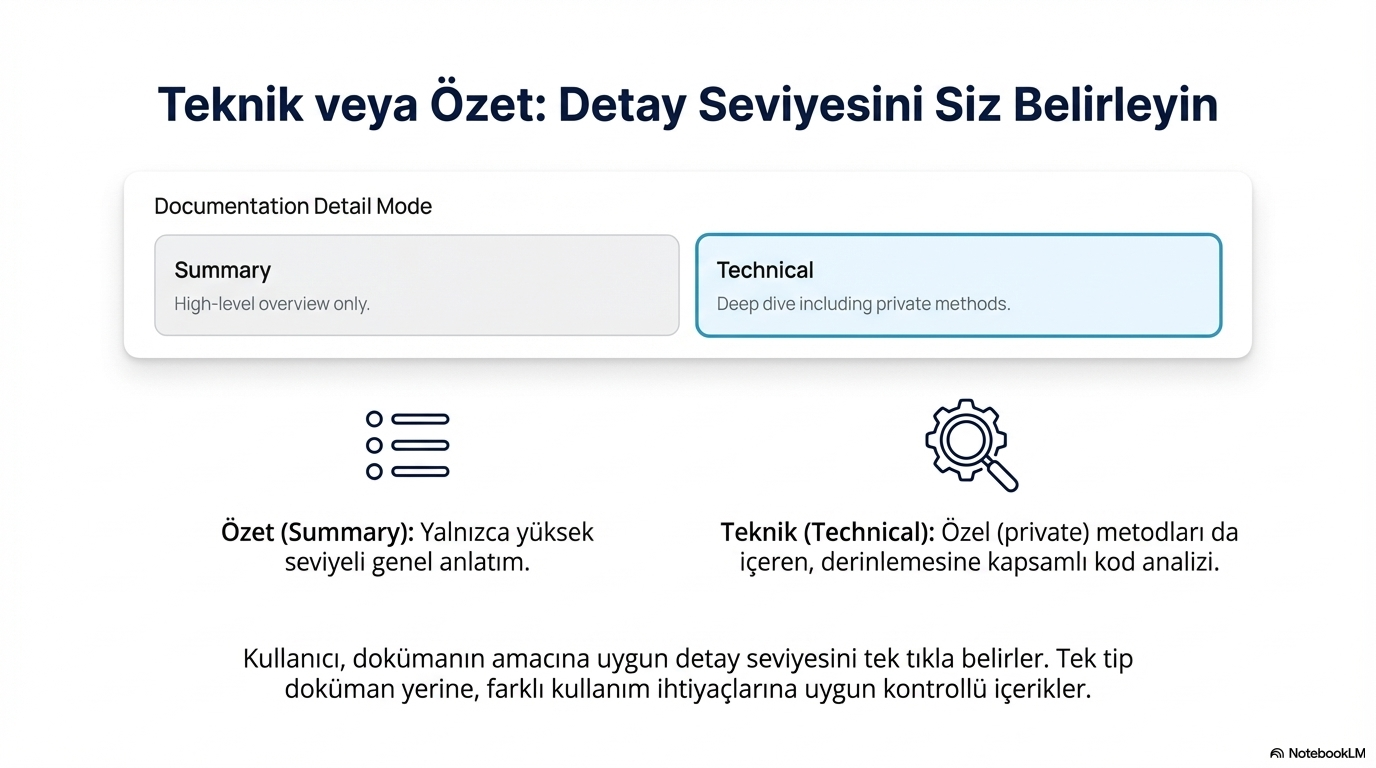
High-level overview only, or deep-dive comprehensive code analysis including private methods.
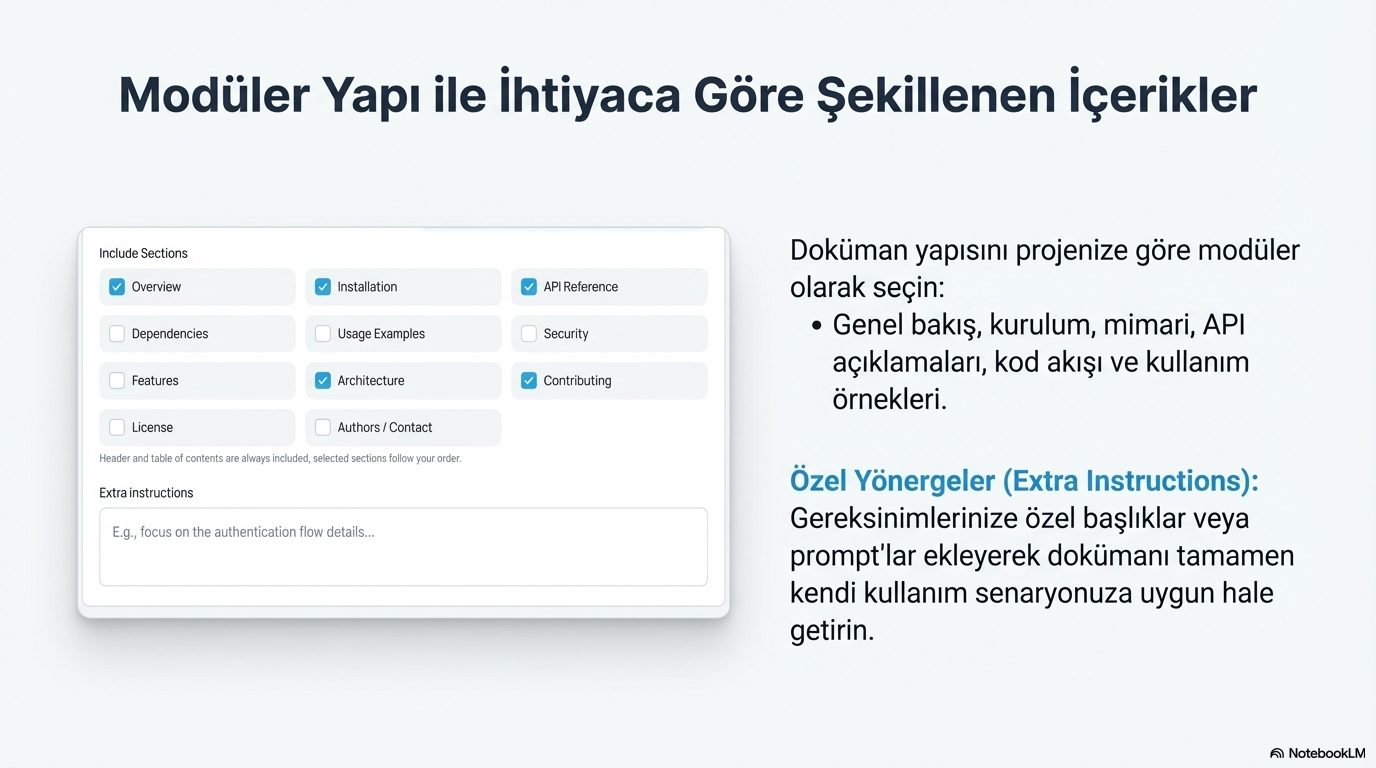
Pick overview, installation, architecture, API reference, usage examples, and more as needed.
Add titles or prompts specific to your requirements to tailor the document to your use case.
Markdown document displayed in real time during generation; table of contents created automatically.
Download the generated document as PDF, copy to clipboard, or publish directly to Confluence.
Source (Bitbucket), AI & Settings, and Output Preview — three areas unified in one panel.
Thanks to language support, documents can be created in both Turkish and English; content production stays fully consistent across teams.
Determine the detail level suitable for the document purpose with a single click; controlled content for different usage needs.
Choose the document structure modularly: overview, installation, architecture, API descriptions, code flow, and usage examples.
Export the created document as you wish or add it directly to the desired area on Confluence.
Centralized Management: In-team documentation management from a single center. The process speeds up, and content always remains standard and up-to-date.
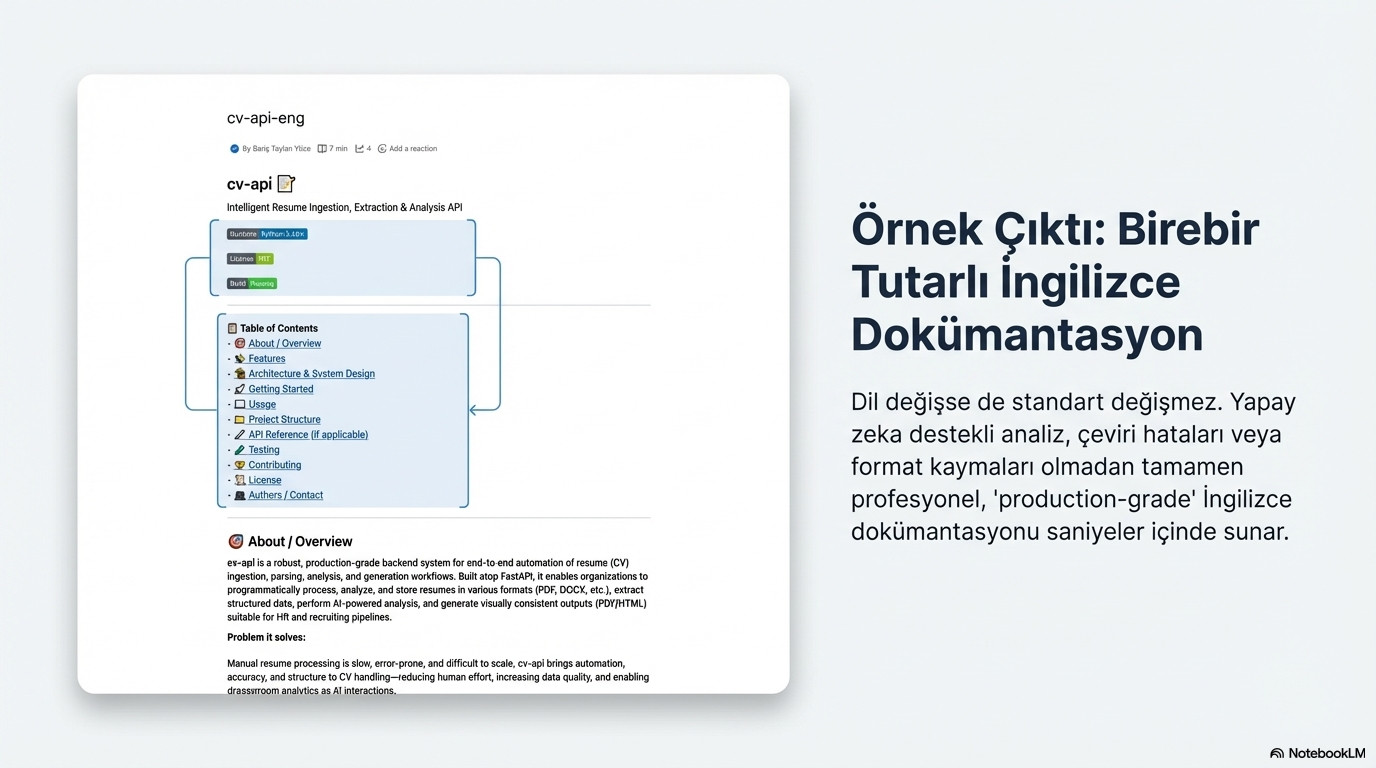
Production-grade documentation with automatic table of contents, clear headings, and architecture & system design sections.
Even if the language changes, the standard does not. AI-powered analysis delivers completely professional, production-grade English documentation in seconds — without translation errors or format shifts.
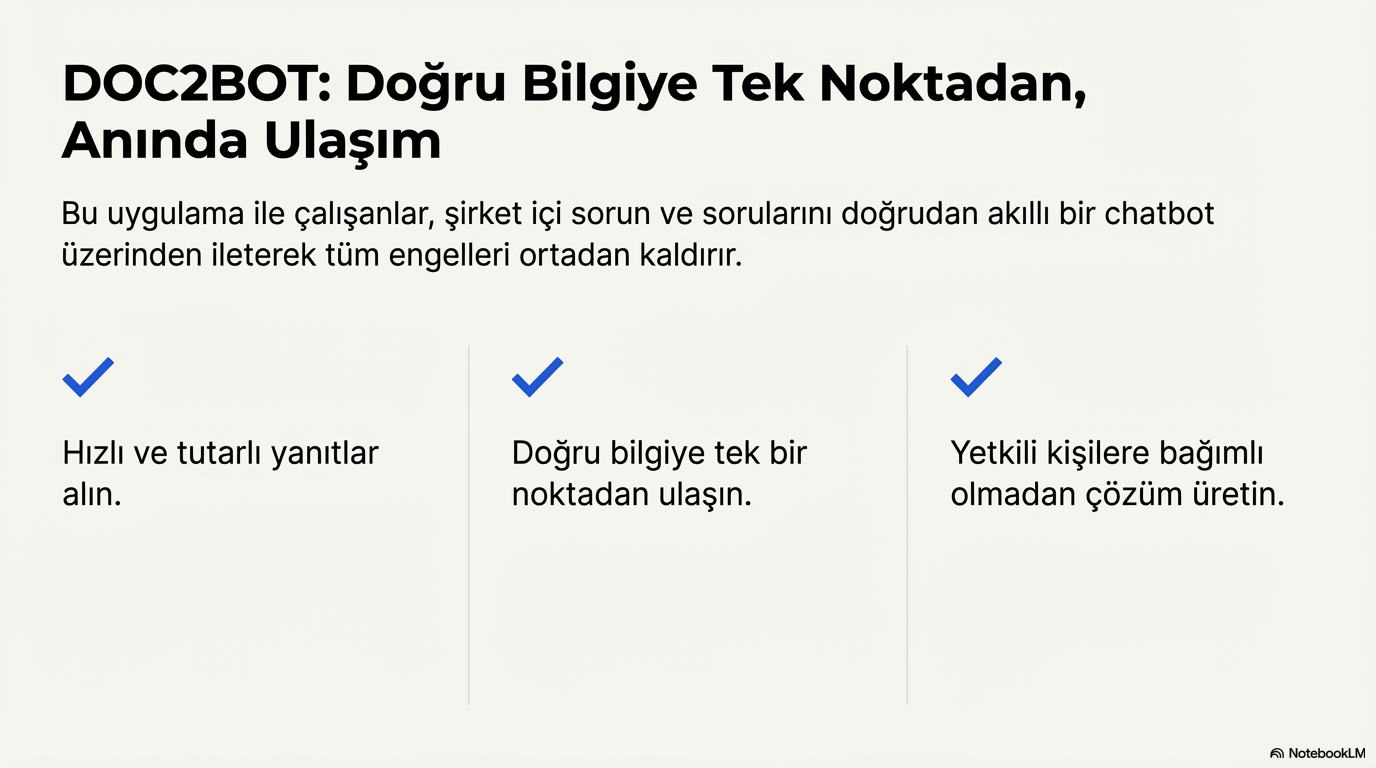
With this application, employees eliminate all obstacles by communicating their internal problems and questions directly through a smart chatbot.
Accelerate internal information flow with artificial intelligence and maximize operational efficiency.
Get instant, standardized responses to repetitive questions.
Reach accurate information from one place without chasing authorized contacts.
Generate solutions without depending on specific individuals.
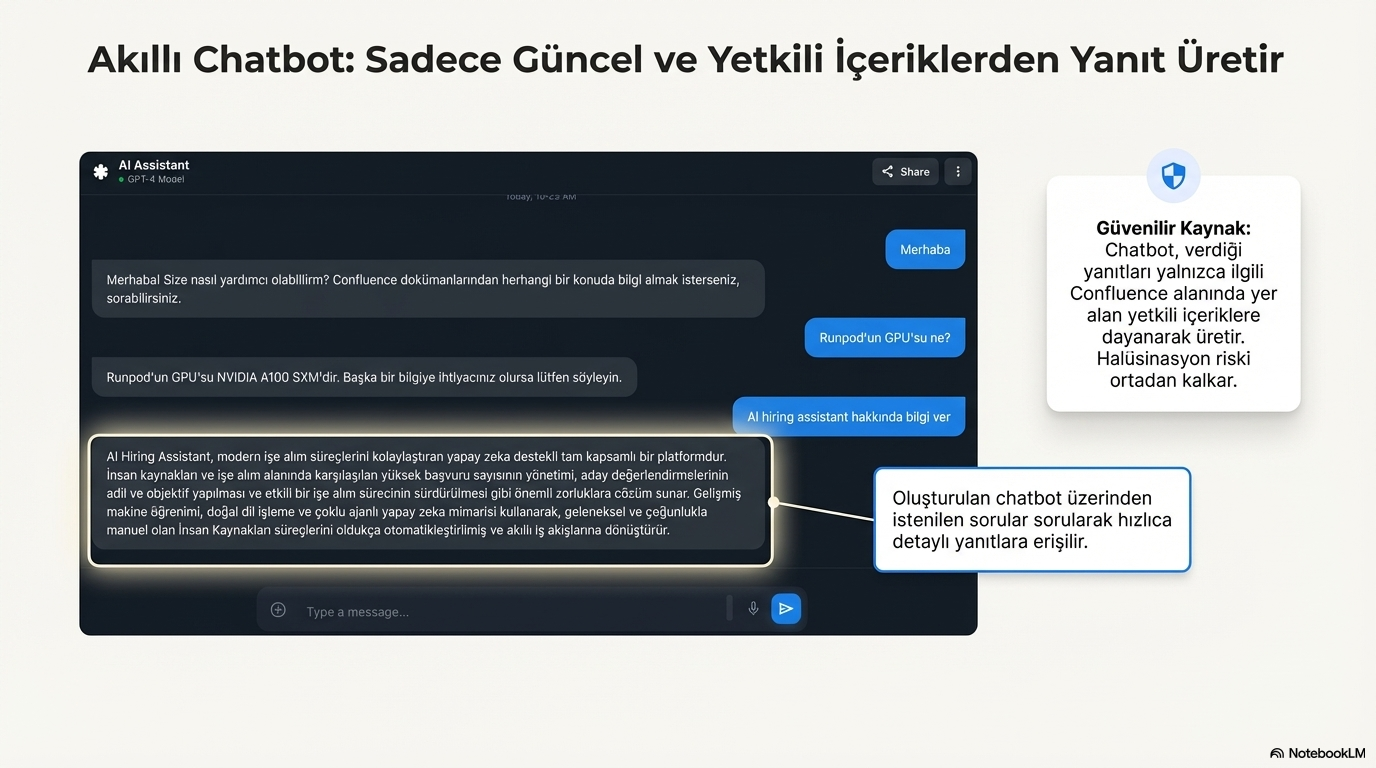
Responses are generated only from authorized Confluence content.
When internal knowledge is scattered, employees must find the right person, wait for answers, and deal with inconsistent information.
Repetitive questions cause authorized personnel to use their time inefficiently.
Since access to information depends on specific individuals, bottlenecks occur in business processes.
Non-standard responses create inconsistency in inter-team communication and operations.
Scattered information directly and negatively affects the speed of daily operational processes.
Company documents connect to a Confluence space; the DOC2BOT engine indexes content and delivers trusted chatbot responses to employees.
Secure connection to a Confluence space via domain, space, and authorization token.
Authorized Confluence pages are indexed to build an up-to-date knowledge pool.
Central knowledge engine — content analysis, context extraction, and response generation.
GPT-4 powered assistant; generates responses only from authorized content.
Instant access for employees via web, Teams, and API.
Employees can ask the chatbot at any time; repetitive questions are handled automatically and information access time is significantly shortened.
Employees can ask the chatbot at any time; they are not dependent on working hours or person availability.
Repetitive questions that steal teams' time are fully met by the chatbot.
The time to access information is significantly shortened, processes are accelerated.
Domain and space information is easily defined; the chatbot is ready for use in a short time without complex coding.
The chatbot generates responses only from authorized content in the relevant Confluence space, eliminating hallucination risk.
Instead of non-standard responses, the same accuracy of information is delivered every time.
Employees ask for the information they need in natural language; DOC2BOT generates the answer from corporate documentation and delivers it within seconds.
The domain information of the Confluence area to which the chatbot is to be connected is easily defined; the chatbot is made ready for use in a short time without the need for complex coding.
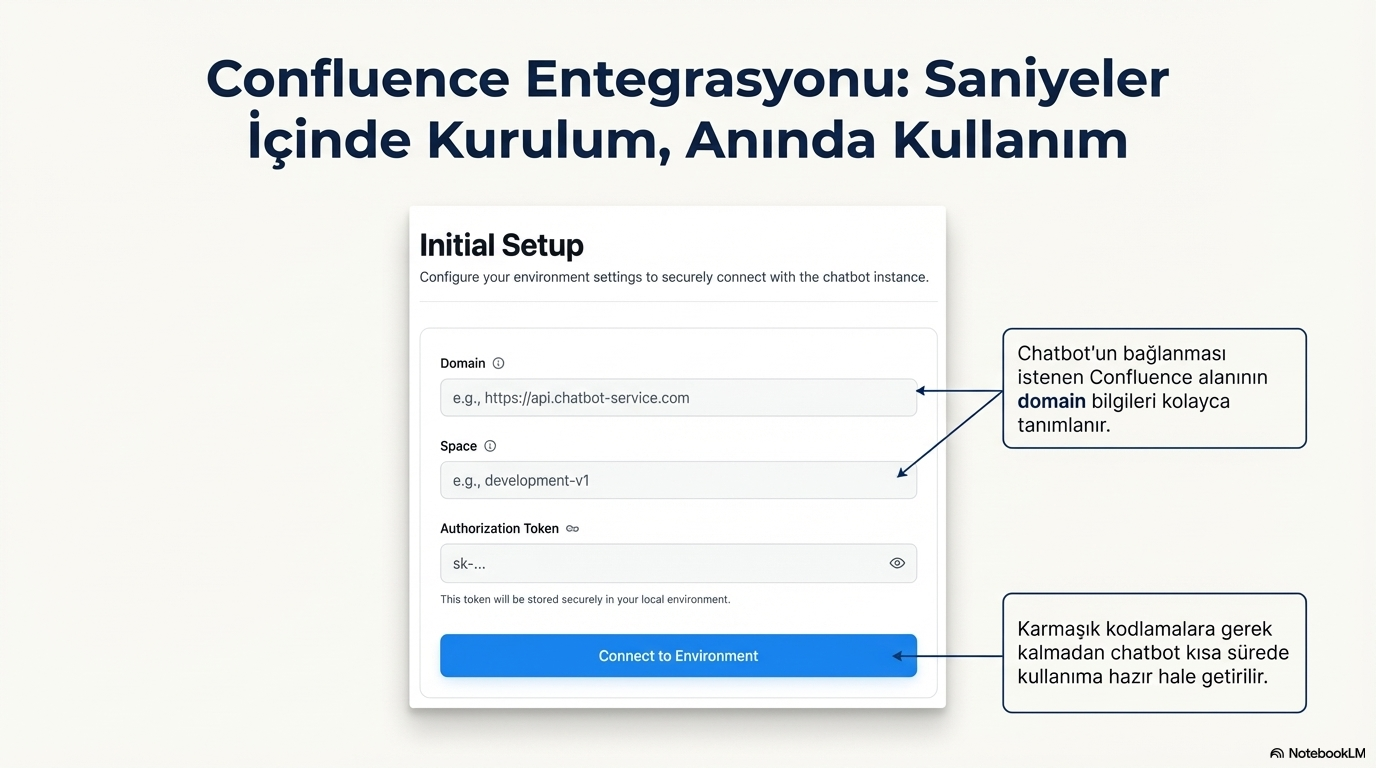
Detailed answers can be accessed quickly by asking desired questions through the created chatbot.
With DOC2BOT, transform hours spent searching for information into value-generating work.
Code Review scans pull requests and commits with AI; classifies findings, delivers a prioritized action plan to developers, and makes merge decisions data-driven.
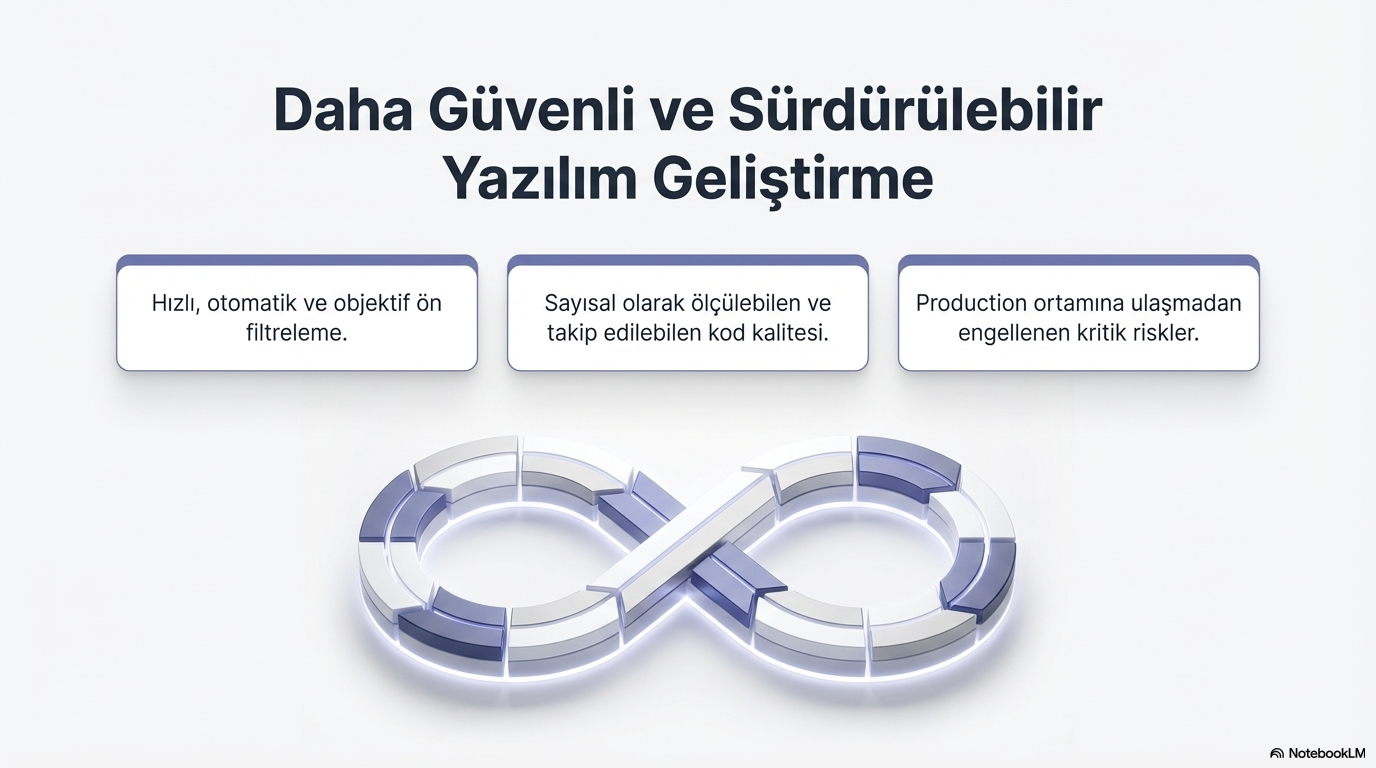
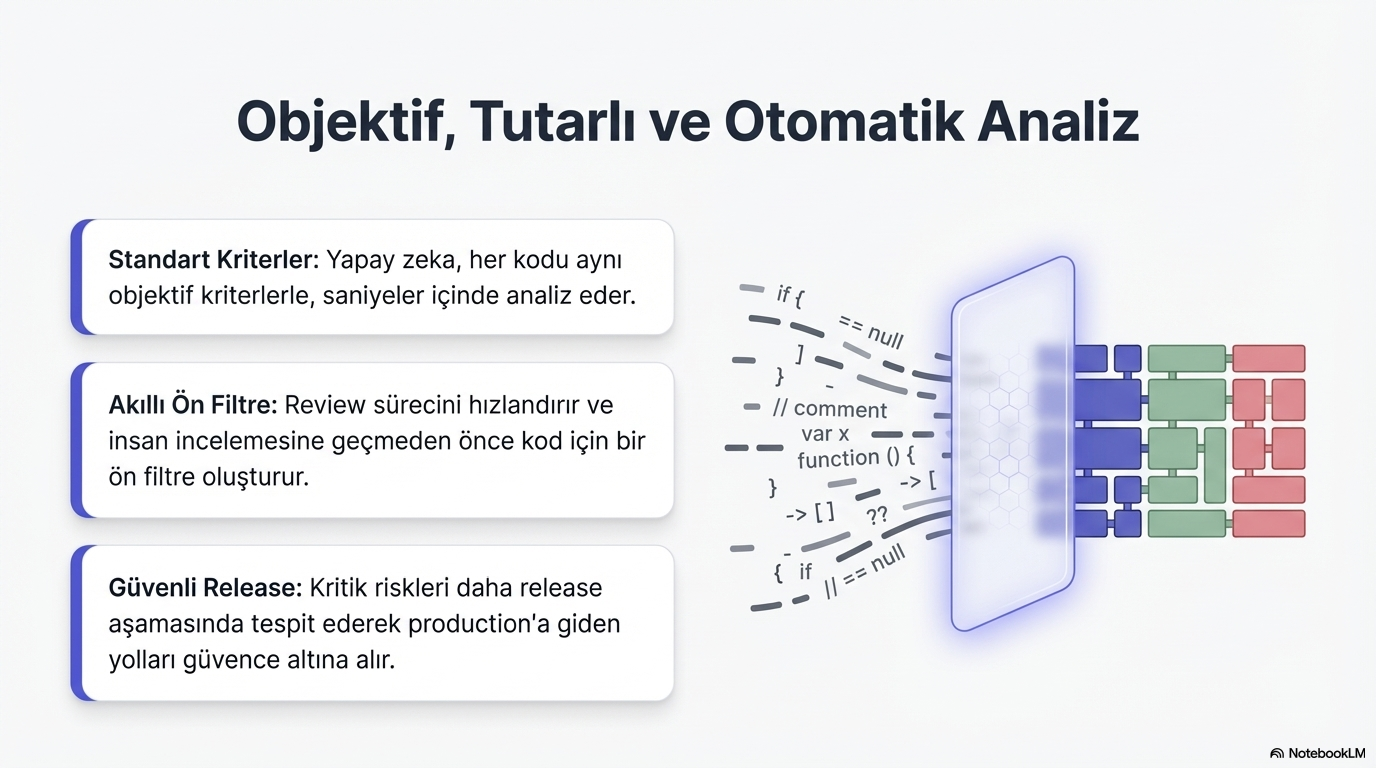
Analyze every code change against objective criteria in seconds; make quality measurable and catch critical risks before release.
Every piece of code is evaluated against the same standard criteria; quality swings tied to subjective comments disappear.
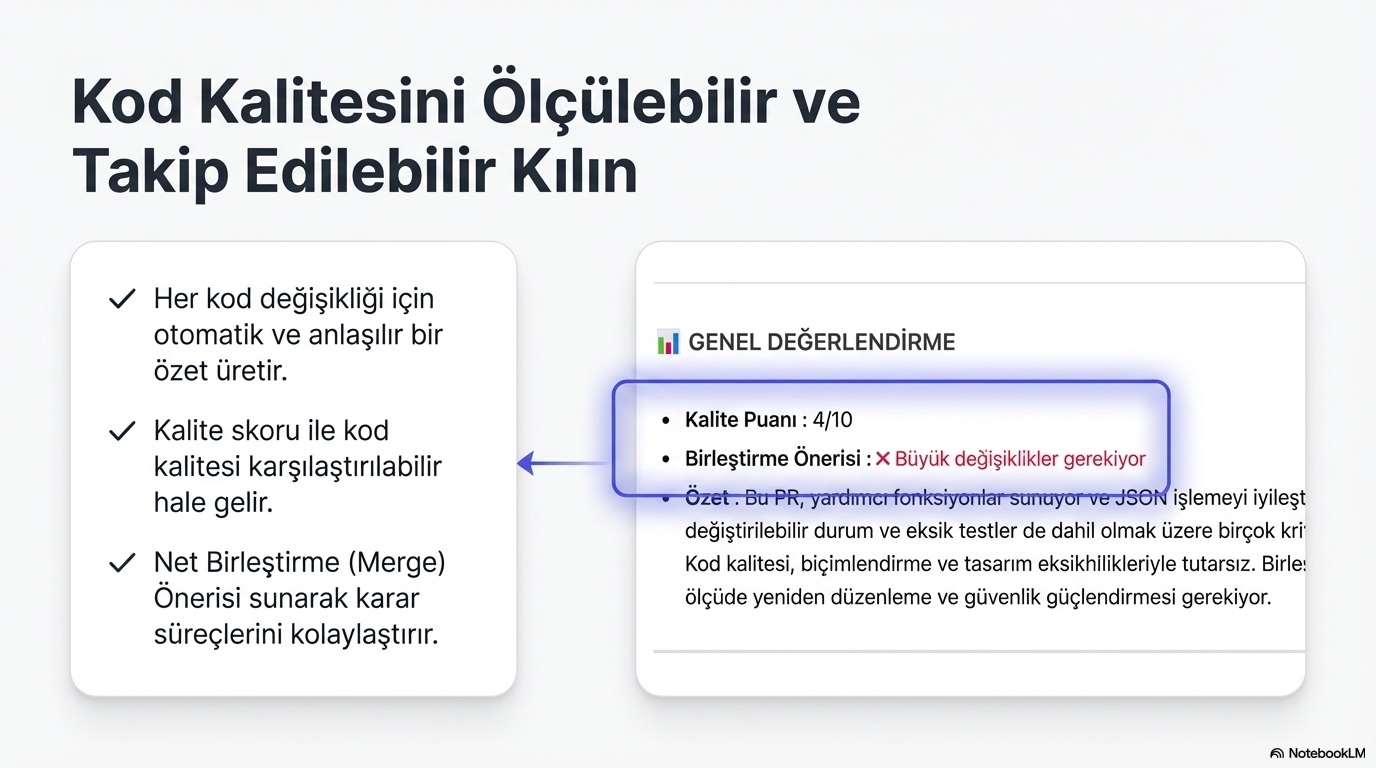
Quality score, automatic summary, and clear merge recommendation accelerate decision-making.
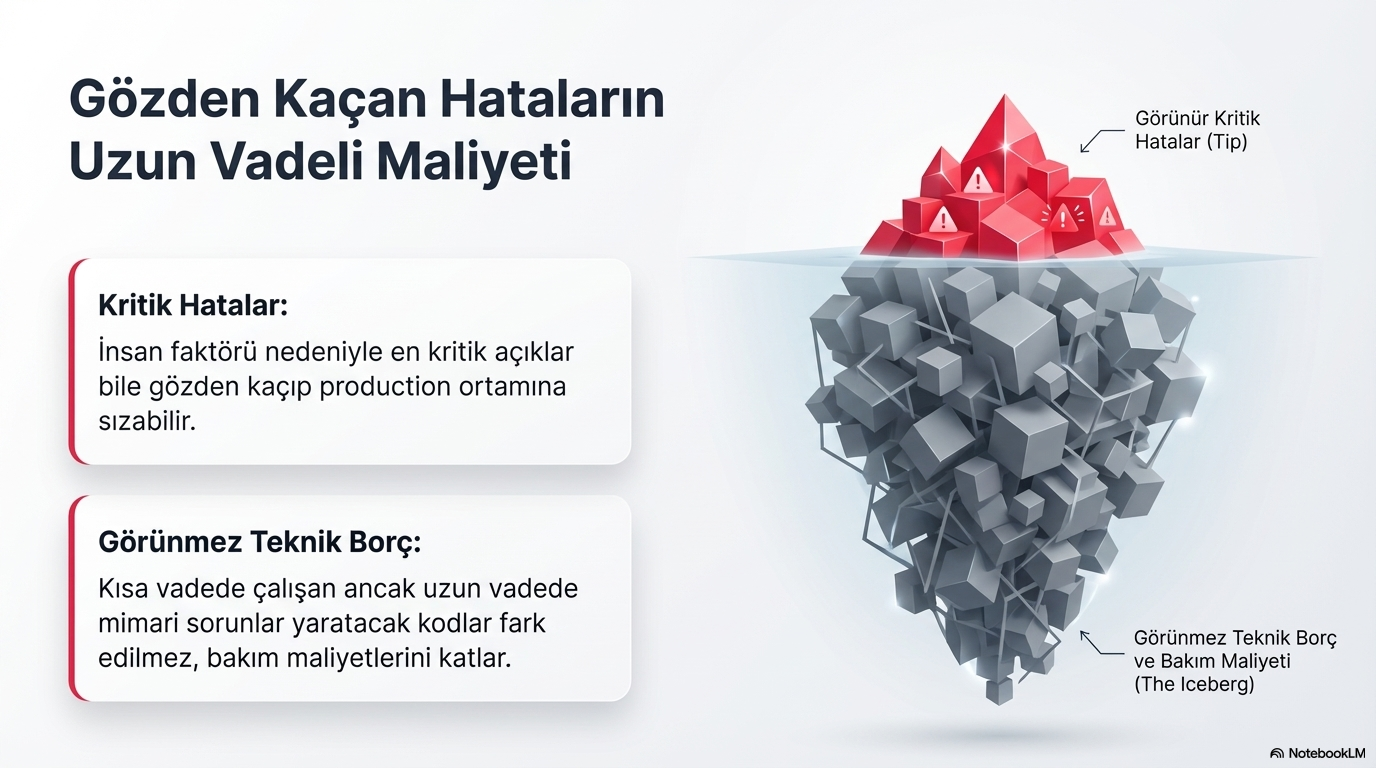
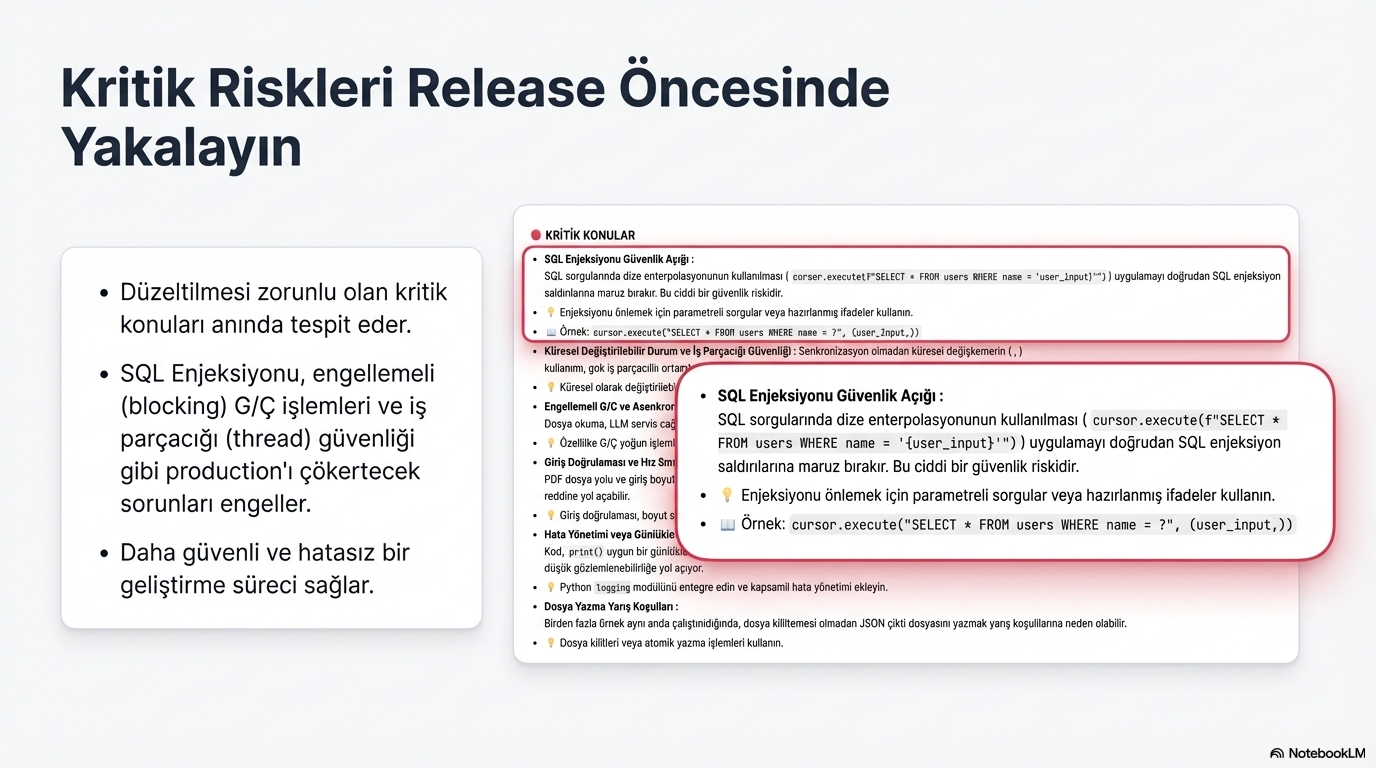
Production risks such as SQL injection, blocking I/O, and thread safety are blocked before release.
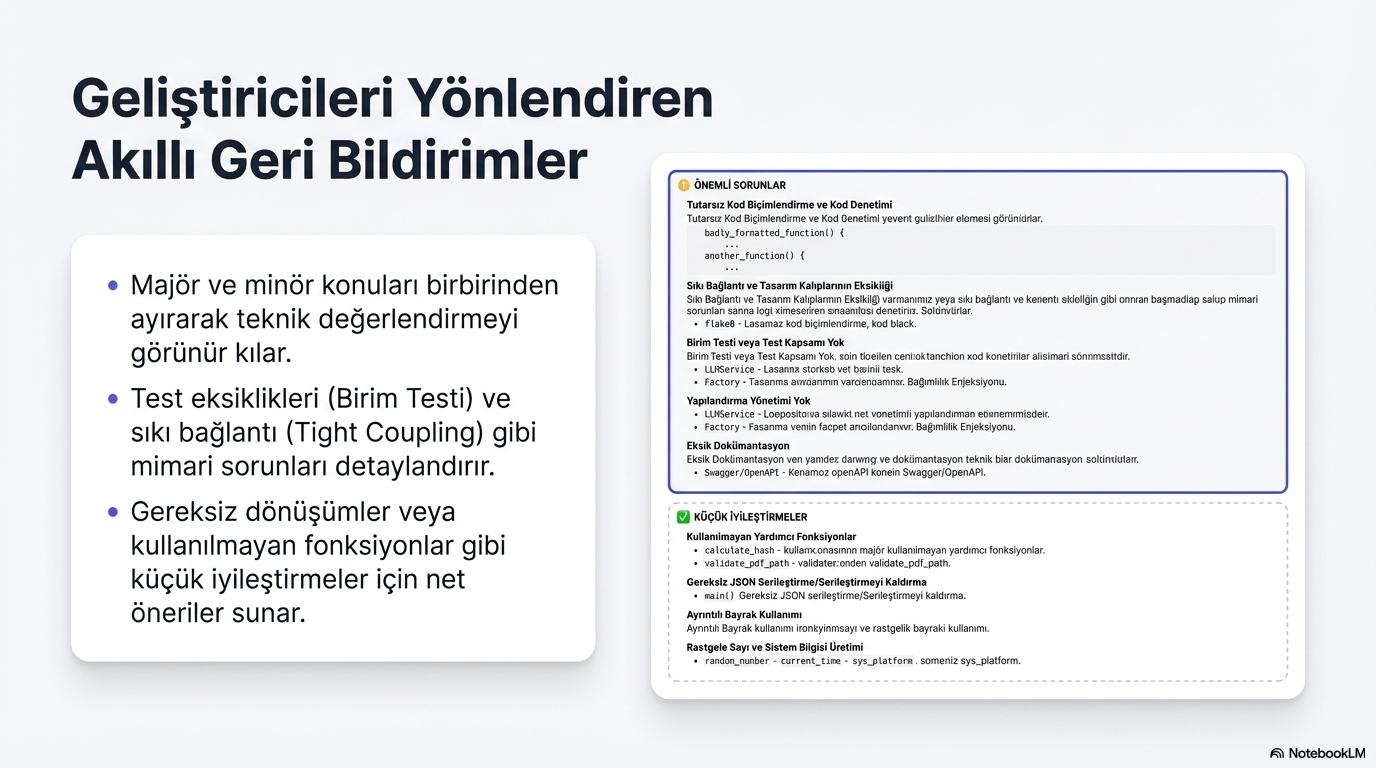
Major and minor issues are separated; line-by-line actionable suggestions and positive highlights are provided.
Traditional code review processes reduce team velocity, fail to maintain consistent standards, and make it impossible to track project-wide quality numerically.
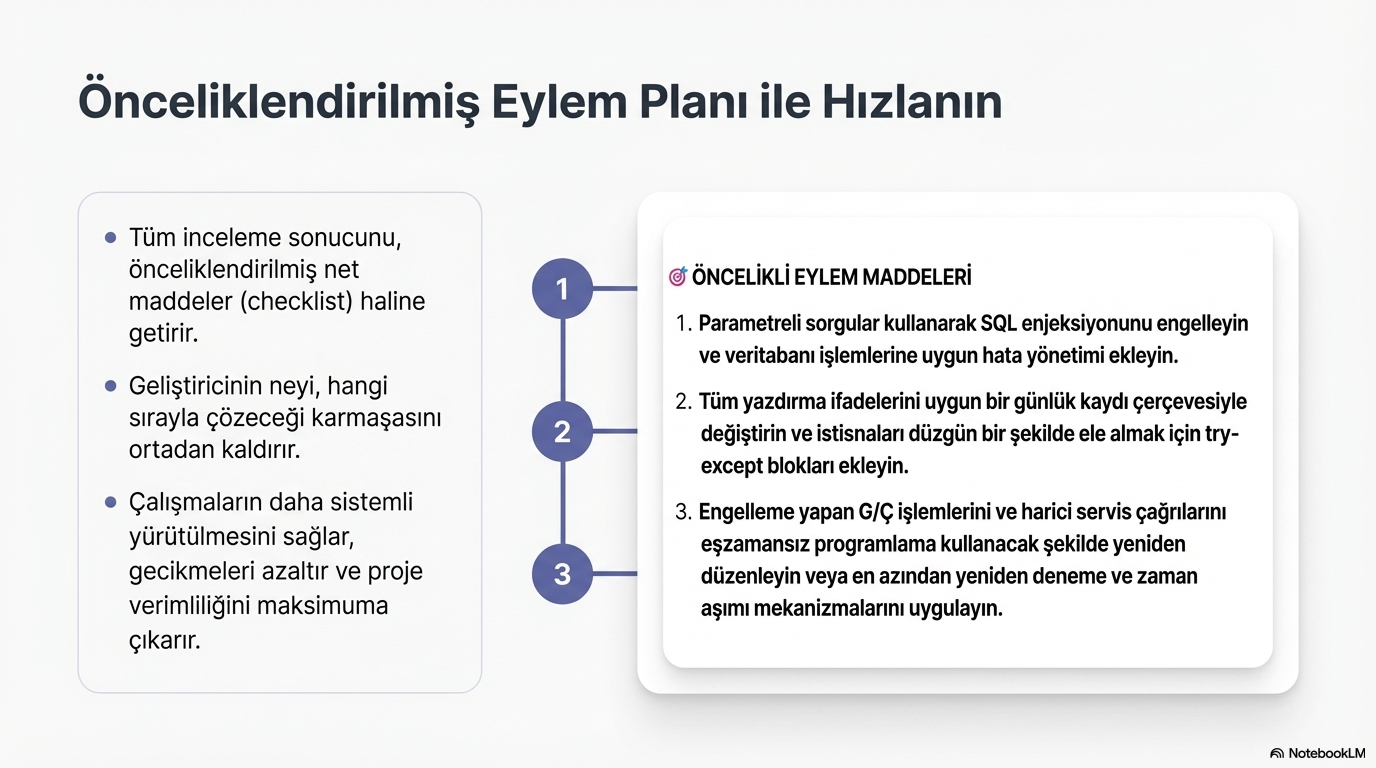
Manual review processes take hours and reduce sprint speed.
Code quality depends on the reviewer's current perspective and experience; standards cannot be maintained.
Code quality and progress across the project cannot be tracked numerically.
When a commit or pull request is submitted, static analysis and AI review kick in; findings are classified, and after developer approval a merge or report is produced.
The developer submits a code change as a pull request or commit.
Code structure, patterns, and known anti-patterns are scanned automatically.
Central review engine — AI analysis, classification, and reporting orchestration.
AI evaluates code against objective criteria; produces critical, major, and minor findings.
Critical risks, important issues, minor improvements, and positive highlights are separated.
Prioritized action items are presented to the developer; approval follows completed fixes.
Merge decision or detailed review report is produced with quality score and merge recommendation.
End-to-end review experience — from standard criteria to line-by-line suggestions, quality scores to prioritized action plans.
AI analyzes every piece of code against the same objective criteria within seconds.
Speeds up the review process and creates a pre-filter for code before human review.
Generates an automatic summary, quality score, and clear merge recommendation for every code change.
Prevents issues that would crash production, such as SQL injection, blocking I/O, and thread safety.
Separates important issues from minor improvements; details architectural debt and test gaps.
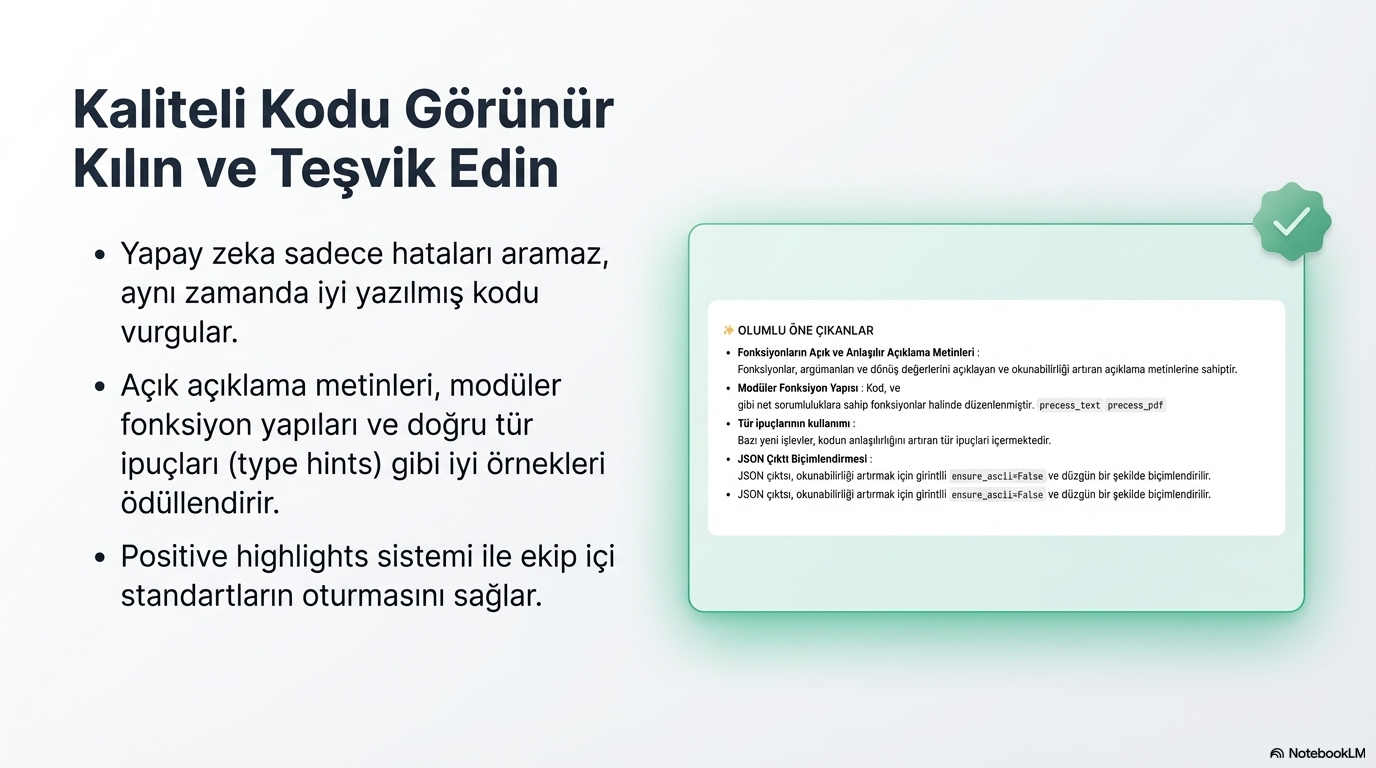
Highlights quality code examples such as clear docstrings, modular functions, and type hints.
Does not leave issues general; points out exactly which lines they are in and suggests applicable fixes.
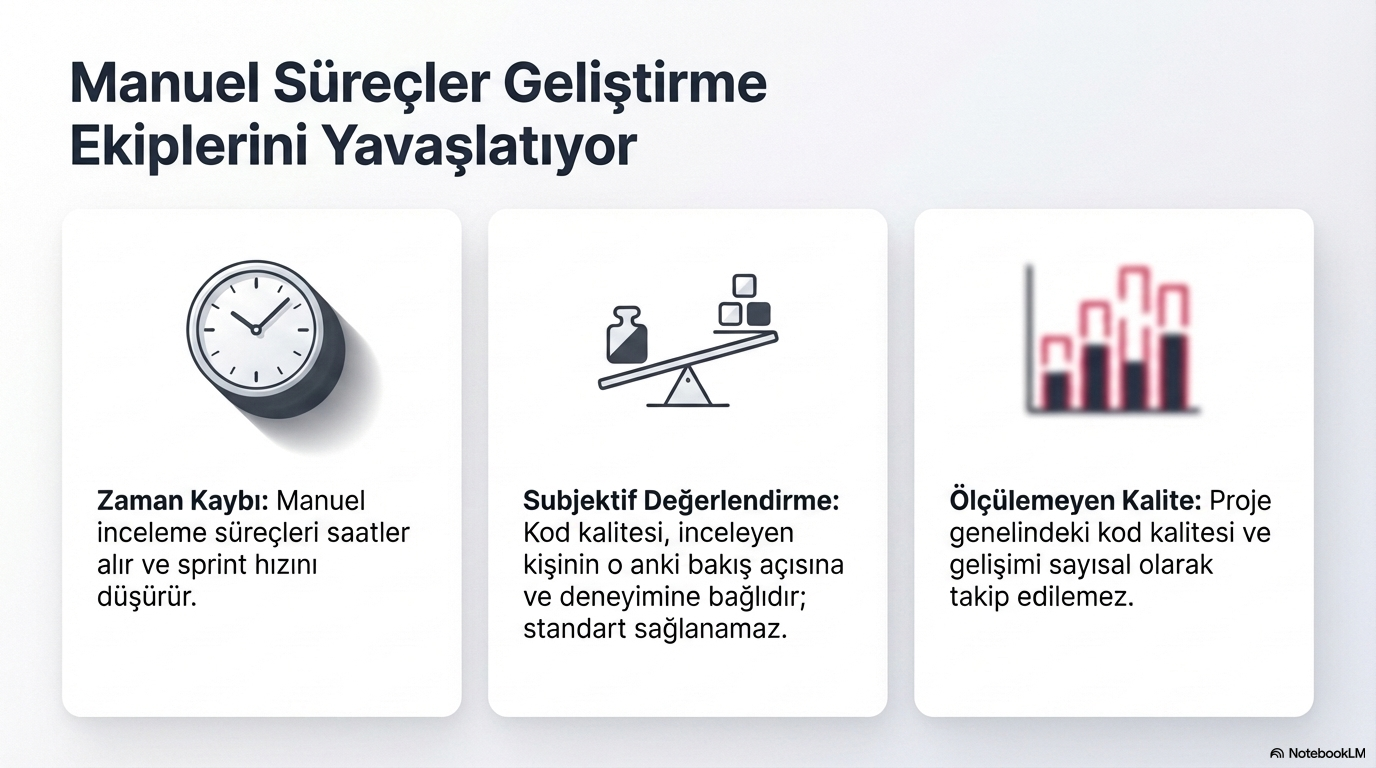
Converts all review results into prioritized clear items; clarifies what the developer should fix and in what order.
Scattered code fragments pass through the AI filter and are classified against standard criteria.
Quality score and merge recommendation clarify decision processes.
Critical issues that must be fixed are detected instantly and presented with detailed explanations.
Makes technical assessment visible by separating major and minor issues.
AI doesn't just look for errors; it also highlights well-written code.
Exact line references and instantly applicable solution suggestions for every issue.
All review results are converted into clear, prioritized checklist items.
IVR is a voice AI platform that speaks in natural language. It manages inbound and outbound calls, routes them to the right unit, performs voice analysis, and automatically runs and reports on survey and information calls. CallBot is your digital assistant that automatically calls the candidate pool for open positions and conducts short interviews in fluent Turkish.
The decision stays with you — automate pre-screening and operational load.
Understands intent and routes the call to the right place.
Real-time speech-to-text and text-to-speech.
Completes survey and information calls.
Reports call results and voice analysis.
CallBot runs end to end — from introduction and KVKK consent through identity verification, interview, and HR dashboard reporting.
The candidate is called; the bot introduces itself and reads the KVKK disclosure text.
The interview never starts without keypad consent.
If consent is not given, the call ends and all data is permanently deleted.
Verification of the last 4 digits of the Turkish ID — correct person check.
5–15 position-specific questions; answers are listened to and transcribed.
AI-supported analysis, scoring out of 100, and summary report.
Candidate report card, transcript, and audio recording delivered to the HR manager.
Intent and entity extraction from free speech.
Rule and intent-based automatic routing.
Speech quality and tone analysis.
Automatic survey/information with standard questions.
Result, duration, and analysis reports.
Corporate secure server and record management.
Runs many parallel calls simultaneously on a list of 800 candidates.
Understands "call me this evening"; algorithmically tracks unreachable candidates.
Detects voicemail, does not leave a message; filters noise.
Politely ends the call early when a critical question receives "No".
Problem: Pre-screening is the biggest time sink for HR teams; 85% of specialist time is spent on calls with candidates who will eventually be eliminated.
Flow: CallBot automatically calls the candidate pool, runs KVKK consent and ID verification, conducts a position-specific interview, and produces a candidate report card with AI scoring.
Outcome: The HR manager receives a final candidate report card with score, strengths/weaknesses, transcript, and audio recording.
Problem: Scheduled meetings are forgotten or seats go empty without attendance confirmation.
Flow: Natural-language reminder calls such as "Do you confirm your technical interview at 14:00 tomorrow?"
Outcome: Attendance confirmations are collected automatically; the HR calendar stays up to date.
Problem: Short surveys via manual calling are expensive and produce inconsistent results.
Flow: Short 5-question surveys run automatically; responses are aggregated on the dashboard.
Outcome: Total score (NPS) is calculated; trend and segment analysis is reported.
Problem: RSVP tracking and soft debt reminders tie up operations teams.
Flow: Participation confirmation for internal/external meetings, or offering finance team contact for payment plan updates.
Outcome: Automatic attendance lists are created; finance operations run with polite voice reminders.